If you’re an exporter planning to import machinery or capital goods, the EPCG Scheme can significantly reduce your costs.
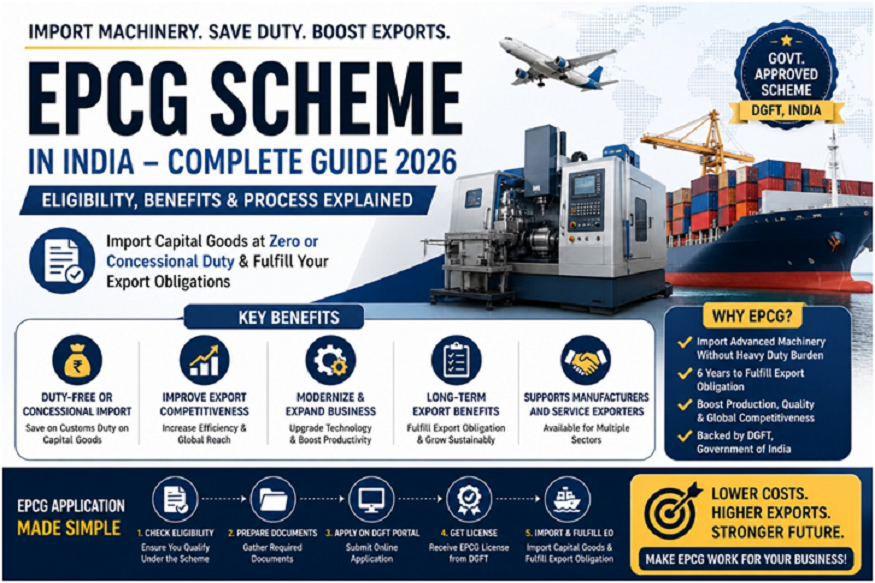
Introduced by the Directorate General of Foreign Trade, the EPCG Scheme allows duty-free or concessional import of capital goods, subject to export obligations.
In this guide, we’ll cover eligibility, benefits, process, documents, and compliance requirements—everything you need to know.
What is EPCG Scheme?
The Export Promotion Capital Goods (EPCG) Scheme enables exporters to import capital goods such as:
Machinery
Equipment
Tools
Technology
zero or reduced customs duty, provided they fulfill export obligations within a specified period.
Key Benefits of EPCG Scheme
✅ 1. Duty-Free Import of Capital Goods
You can import machinery without paying customs duty, reducing upfront investment.
✅ 2. Boost in Export Competitiveness
Lower production costs help you compete better in international markets.
✅ 3. Supports Business Expansion
Ideal for manufacturers and service exporters looking to scale operations.
✅ 4. Long-Term Export Benefits
EPCG encourages sustained exports through structured obligations.
Who is Eligible for EPCG Scheme?
The EPCG Scheme is available to:
Manufacturer exporters
Merchant exporters tied to supporting manufacturers
Service providers (hotels, logistics, etc.)
Read More: How to Check the Clean Max Enviro IPO Subscription Status: A Step-by-Step Guide
Export Obligation Under EPCG
To avail benefits, you must fulfill export obligations (EO):
Typically 6 times the duty saved
To be completed within 6 years
Documents Required for EPCG License
Prepare these documents:
Import Export Code (IEC)
GST registration
PAN card
Business registration proof
Proforma invoice for machinery
Bank certificate
Step-by-Step Process to Apply for EPCG License
Step 1: Check Eligibility
Ensure your business qualifies under EPCG.
Step 2: Prepare Documentation
Gather all required documents.
Step 3: Apply via DGFT Portal
Submit your application online through DGFT.
Step 4: Get EPCG License Issued
Once approved, you can import capital goods.
Step 5: Fulfill Export Obligation
Track and complete your export targets within the timeline.
Common Mistakes in EPCG Application
Incorrect documentation
Miscalculation of export obligation
Not tracking compliance timelines
Lack of proper planning
Read More: What Are Fire-Rated Cables and Why Are They Mandatory in Australian Buildings?
EPCG vs Other Export Schemes
Exporters often confuse EPCG with incentive schemes like:
RoSCTL Scheme
EPCG = Import benefit (capital goods)
RoDTEP/RoSCTL = Export incentives (rebates)
To understand export benefits in detail, check this guide:
Importance of Export Documentation
Many EPCG applications fail due to documentation errors.
To understand export documentation and compliance processes, refer here:
FAQs – EPCG Scheme
1. What is the validity of EPCG license?
Typically valid for fulfilling export obligation within 6 years.
2. Can service providers apply for EPCG?
Yes, eligible service exporters can apply.
3. What happens if export obligation is not met?
You may have to pay duty along with interest and penalties.
4. Is EPCG better than other schemes?
It depends on your business needs—EPCG is ideal for capital goods import.
Conclusion
The EPCG Scheme is a powerful tool for exporters looking to reduce costs and expand operations.
However, success depends on:
Correct application
Proper documentation
Timely compliance